Most mulching advice online is written for climates with a hard winter, where the whole point is insulating roots before a freeze. That advice doesn't transfer well to Pinellas County. Our risk isn't frost — it's UV breakdown and eight inches of rain in a single August month washing a thin layer straight off the bed.
When to Mulch in Florida: The Two Windows That Matter
Spring — March through April
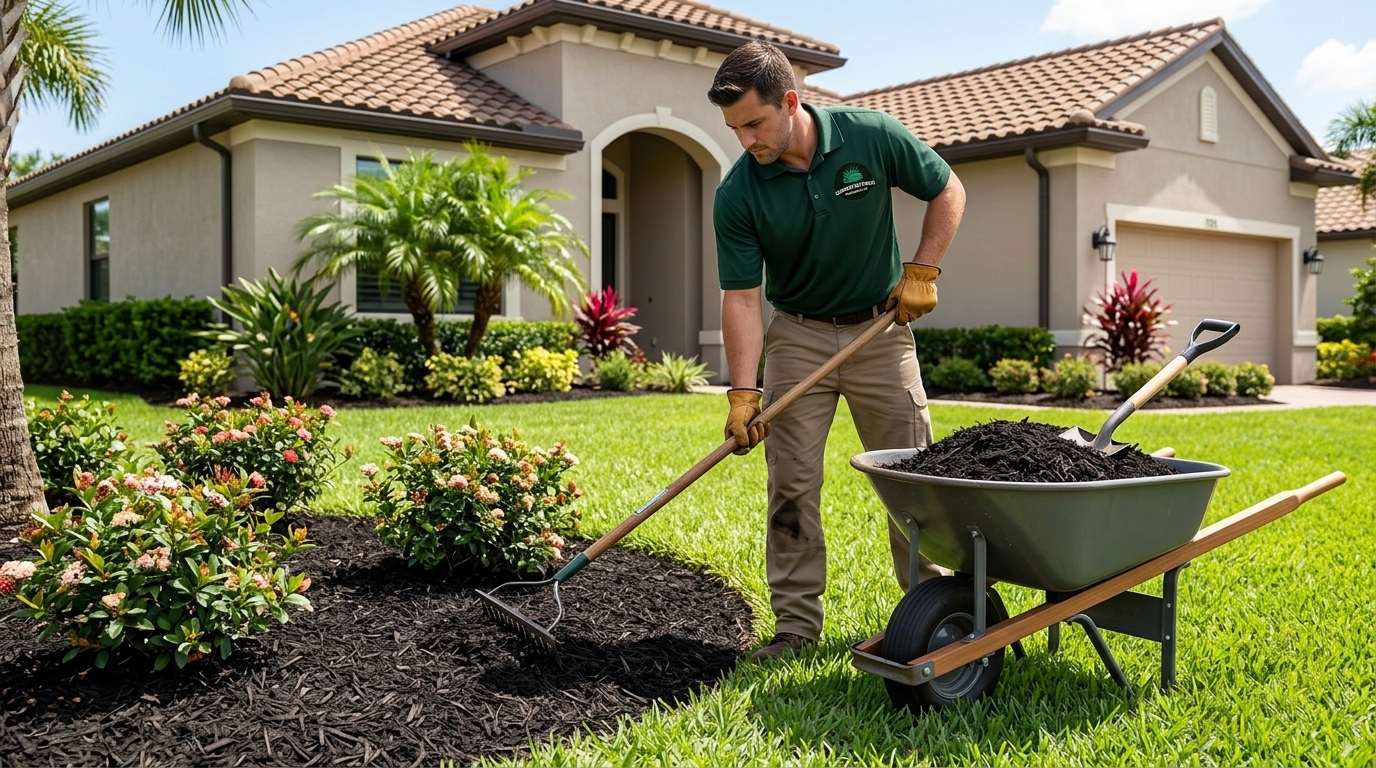
This is the main event. Mulching before the rainy season starts gives a fresh layer time to settle and interlock before the first heavy downpours arrive in late May or June. A settled layer stays put through a thunderstorm. A freshly loose layer floats and migrates toward the lowest point of the bed within the first storm or two.
Fall — a lighter touch, only if needed
Florida's fall isn't a full remulch season the way it is up north, because there's no freeze to insulate against. What fall mulching does here is patch beds that have thinned from a hard, wet summer — sun and rain both eat into mulch depth from May through September, and by October a lot of beds are down to an inch or less. A fall top-up before the cooler, drier months keeps weed suppression working through winter.
Why summer is the wrong time to lay fresh mulch
Two problems stack on top of each other. First, a downpour on freshly loosened mulch — before it has any chance to settle and mat together — moves material fast, especially on any bed with even a slight grade. Second, Florida's heat and humidity accelerate the breakdown of organic mulch considerably faster than in drier or cooler climates, so mulch laid in July is already thinning by September. You're paying for a full application and getting roughly two-thirds of a season's worth of coverage out of it.
| Item | Detail |
|---|---|
| Best time to mulch (main application) | March – April |
| Optional light top-up | September – October, if beds have thinned |
| Worst time for a full application | June – August (peak rain, fastest breakdown) |
| Standard refresh depth | 1 – 2 inches added to existing layer |
Pine straw vs. bark and cypress — different refresh cycles
Pine straw compresses and breaks down fastest of the common mulch types in Florida's heat and humidity, so it typically needs refreshing twice a year — once in spring and again in early fall — to hold consistent coverage. Bark and cypress mulch are denser and hold their depth longer, so once a year in spring is usually enough unless a bed is unusually exposed to full sun and heavy irrigation overspray.
When to Mulch in Florida by Canopy and Neighborhood
The March-to-April window is the right target everywhere in Pinellas County, but how much that first spring layer actually needs to cover varies with canopy. Older, oak-canopied streets in Belleair and Dunedin drop leaf litter through spring that partially insulates beds on its own, so those beds often hold their depth a few weeks longer into summer than a bed in full sun. Newer, more open subdivisions in Safety Harbor and Palm Harbor get direct sun most of the day, which means faster UV breakdown and a stronger case for that optional September check-in, not just a spring application. If your property spans both conditions — shaded foundation beds and a sunny mailbox island, say — it's worth treating them on two different refresh schedules rather than mulching the whole property on one calendar date.
What Mulch Actually Costs on a Spring Schedule
Pricing follows material and depth more than timing, but a spring-scheduled full application typically runs $85 to $120 per cubic yard installed for pine bark or cypress, and $75 to $100 per cubic yard for pine straw, both figures including spreading labor and edge cleanup. A typical Clearwater property with 400 to 600 square feet of beds at a 3-inch depth uses 4 to 6 cubic yards, putting a full spring refresh in the $350 to $650 range for most single-family lots. Getting that application in during March or April rather than July is effectively free — same material cost, close to double the usable coverage life out of it.
Mulching around new sod and new plantings
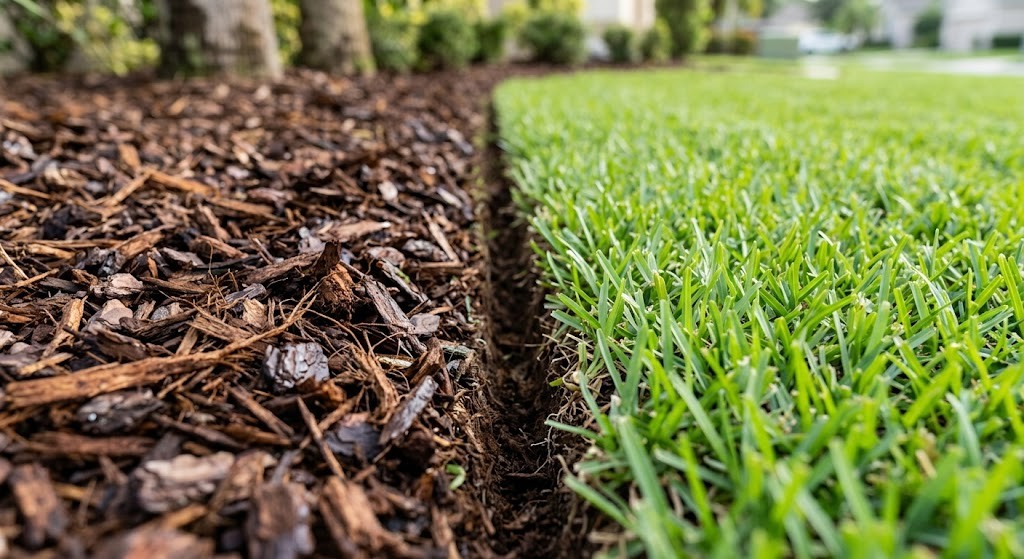
New sod and freshly installed beds change the timing math slightly. Mulch right up against new sod edges as soon as the sod is down — it protects the exposed soil line and keeps the edge from eroding into the grass before the roots knit in. For new plants, hold off on a full 3-inch layer for the first couple of weeks and use a lighter 1-inch layer instead, so you can still see the soil surface and check that irrigation is actually reaching the root ball. Piling full-depth mulch on day one over a plant that hasn't rooted in yet can trap more moisture than the roots can use.
Which mulch type holds up best through a Florida wet season
Material matters as much as timing. Cypress and pine bark nuggets are heavier and denser, so they resist floating and washing during a downpour far better than shredded or dyed mulches, which are lighter and more prone to migrating downhill on any bed with slope. Pine straw interlocks as it settles and resists washing surprisingly well for how light it looks, which is part of why it remains popular on sloped beds in Pinellas County despite needing more frequent refreshing. Rubber mulch doesn't break down or wash at all, which is a genuine advantage in high-rain areas, though it doesn't feed the soil the way organic mulch does as it decomposes.
Signs a bed needs mulch now, regardless of the calendar
- Soil is visible through the layer in patches, especially near the front edge of the bed.
- Weeds are establishing faster than usual — thin mulch lets more light reach the soil and germinate seed.
- The bed dried out noticeably faster than neighboring beds during the last stretch without rain.
- Existing mulch has gone grey and matted rather than holding its color, a sign it's fully broken down rather than just faded.
Prepping Beds Before You Mulch
A spring mulch date is also the right time to handle everything a fresh layer will otherwise just cover up. Pull winter weeds before they set seed under the new mulch rather than through it, and check that bed edges — along driveways, walkways and lawn lines — are cut clean so the new layer has a defined border instead of spreading into the grass. If beds have settled unevenly or lost their grade over a few seasons, that's worth fixing at the same time rather than mulching over a problem; see our lawn bed prep and leveling page for that step, and landscape edging if the borders themselves need rebuilding, not just trimming.
What this means for scheduling your yard
If you're doing your own mulch calendar, the short version is: full application in March or April, before the rain starts, and a spot check in September to see if pine straw beds or high-sun beds need a top-up. That's the schedule that survives a Florida wet season rather than fighting it. Full pricing and coverage detail is on our mulch installation page, and if you're not sure how deep to go, see our companion piece on the right mulch depth for Florida landscaping. We also handle bulk mulch delivery if you'd rather spread it yourself, and if new sod is part of the same spring project, our guide on sod cost in Clearwater covers how to budget both at once.